
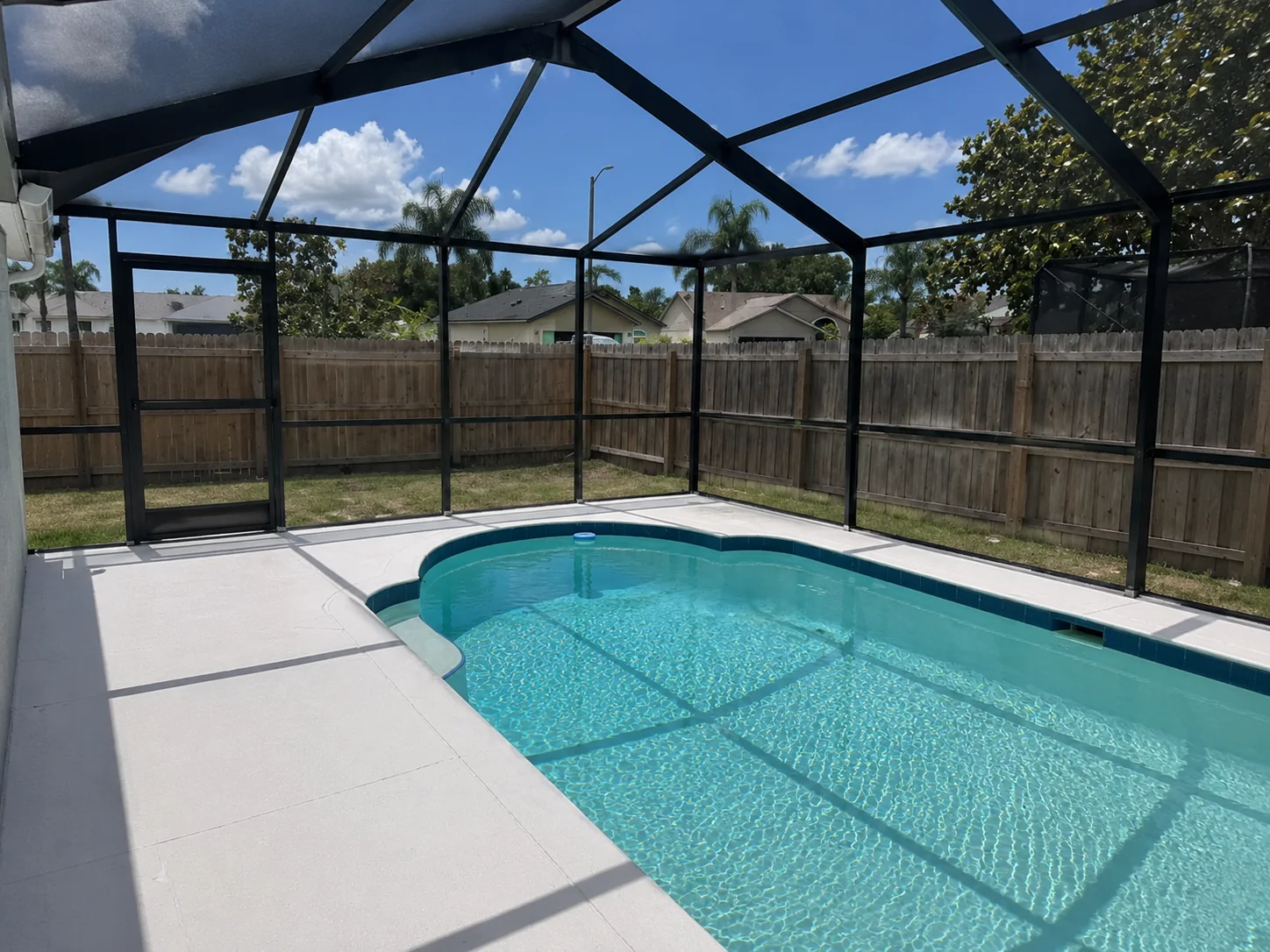

Pool cage restoration in Tampa is two trades on one cage, and the prices stay separate. A straight repaint on a sound frame runs $1,800 to $4,500. Rescreening that frame, when the mesh is the problem, runs $1,200 to $3,500. Paint plus a rescreen runs $3,500 to $7,000. A full replacement runs $8,000 to $25,000. Those are 2026 market ranges, not a bid for the cage in your yard.
Westchase Painting Company paints the aluminum. A screen company installs the mesh. The crew does not install screen. New mesh goes on after the coating has cured. The service page with the same ranges is pool cage restoration. Paint-only steps are on pool cage painting. The short decision guide is rescreen, repaint, or replace.
Which number applies
| What you see | The job | 2026 market range |
|---|---|---|
| Chalky or dull frame, screen still tight | Wash, treat light rust, repaint | $1,800 to $4,500 |
| Torn screen, black mildew on the mesh, spline pulling out, frame still straight | Rescreen. Paint only if the frame needs it too | Rescreen $1,200 to $3,500. Both $3,500 to $7,000 |
| Bent, split, or rusted-through members | Replace those members before any coating | Replacement of the cage $8,000 to $25,000 |
Size, height, and how much rust has to be treated move a repaint inside $1,800 to $4,500. A single-story cage with light chalk sits toward the low end. A tall cage, or one with rust at the screws and the joints, sits toward the high end. The screen company moves the rescreen number. Mesh type is their material, and this page does not price it.
A search for “pool cage cost” or “cost of a pool cage” is often a new enclosure. Use the $8,000 to $25,000 line for that. Do not put a coating quote next to a new-cage quote and treat them as the same product. Restoration is the spend when the tubes are straight. Replacement is the job when the frame has failed.
Pool cage restoration near me
The cages this crew paints are in Westchase, Carrollwood, South Tampa, Oldsmar, and Odessa. “Near me” usually means the owner wants one company to handle the chalk and the torn screen. The work still splits. Painting a chalky frame and stapling new spline are different trades. Hiring the screen company onto a frame that still has dead coating means the new mesh outlasts the paint, and someone pays to work around fresh spline later.
What the restoration includes
On a straight cage the painting crew washes the frame, treats light rust, replaces screws that have a rust halo, and coats the aluminum.
The wash has to take the chalk off. Chalk is oxidized paint, a white dust that wipes onto your hand. It is not rot. Aluminum does not rot. A coating brushed over that dust peels, sometimes in a season, because the new film bonded to powder. Homeowners replace whole cages because the chalk looks structural. If you can sight the beams and they are straight, and a finger does not go through the metal, the wash and the coating are the job.
Screws fail before the beam does. A brown ring under the screw head is the fastener, not a dead cage. Those screws come out. Stainless steel fasteners go back in. Surface rust is wire-brushed or sanded and treated. A member that is bent, split, or rusted through is not a paint step. Coating that piece hides the failure. Those members are replaced first, by the trade that builds cages, and then the remaining frame can be painted.
Screen comes off when it is torn, when the spline is loose, or when overspray would ruin mesh you meant to keep. Sound screen can stay. It is masked, and only the frame is painted. Torn screen, black mildew in the mesh, or spline pulling out of the channel means the mesh is finished. The screen company rolls new mesh after the coating has cured.
How to restore a pool cage, in order
- Look at the frame before anyone prices a color. Straight tubes can be painted. Bent, split, or rusted-through tubes are a replacement conversation.
- Decide whether the screen stays. Tight screen gets masked. Dead screen comes off.
- Wash the chalk off. Treat light rust. Replace rusted screws.
- Coat the aluminum.
- Wait for the cure. July humidity adds hours. Furniture stays off the deck until that time is up.
- The screen company installs mesh if the old mesh was removed.
Painting first and rescreening later works. The reverse, new mesh on a chalky frame, does not. The Florida painting guide covers the coating steps in more detail. This post is the money and the order.
Rescreen cost, and who does the mesh
Rescreening a sound frame runs $1,200 to $3,500. Paint and a rescreen together run $3,500 to $7,000. Westchase Painting Company does not install screen, does not sell mesh, and does not repair a single torn panel.
A “pool cage screen repair near me” search belongs with a screen company. They choose standard fiberglass, a tighter weave for no-see-ums, or a heavier pet screen. They also decide whether one panel is enough or the whole cage needs new spline. Quoting those materials from a painting crew would be a guess. What this crew can price is the coating, and whether the frame is sound enough to take it.
If you already have a screen company scheduled, put them after the paint, not before, unless the mesh has to come off so the frame can be washed. Tell both sides that order when you book. Two crews on the same morning, one rolling mesh and one spraying a beam, is how overspray ends up in new screen.
How long the paint lasts
A prepared and painted cage typically lasts 5 to 8 years. The wash, the rust treatment, and whether the cage gets rinsed later are what move a job inside that span. Chlorine off the pool water and full sun hit the top beams every day. A hardware-store spray can is not that coating. The painting page specifies a direct-to-metal coating for the aluminum.
Five to eight years is the coating. It is not a promise that the cage will stand there like a new one for decades. A new enclosure is the $8,000 to $25,000 range, and it is a different product. Paint does not add that life to a frame that has already bent.
The pool, the lanai, and a two-story cage
Stay out of the pool during the work. A straight paint job is typically 2 to 4 days. The wash puts grit in the water. Overspray can reach the surface even with the deck masked. When the coating has cured and any new screen is in, the pool can be used again.
A lanai or a patio screen room is the same aluminum and the same coating, with less chlorine, so the rust work is often lighter. People searching “screen enclosure painting” are usually describing that frame or a pool cage. Two-story cages need scaffolding. Upper members often carry more rust, because water sits in the top joints. The painting page covers that access. The dollar ranges on this page still apply if the mesh is part of the scope, and the screen is still not our install.
If the house stucco is failing on the same visit, that is exterior painting or stucco repair. The cage does not get rolled with the wall paint.
The combined price is its own range
A straight repaint can start around $1,800. A rescreen on a sound frame can start around $1,200. Paint plus a rescreen is its own range, $3,500 to $7,000. Adding those two floors produces $3,000, and that sum leaves out the cure day and the second crew.
The gap is the work between the two trades. Dead screen has to come off before a real wash. The coating has to cure before new spline goes in. The screen company is a second crew, on a second day, after that cure. A cage that needs both is not the cheapest paint job plus the cheapest screen job stapled together. If someone quotes you the sum of the two floors, ask whether the cure day is in the number.
The high end of the combined range, $7,000, is still under the floor of a full replacement, which starts at $8,000 and runs to $25,000. That comparison holds only when the frame is worth coating. A bent cage that “saves money” by taking paint is a coating on a failed frame.
Color on the frame
The colors already specified for these cages are bronze, dark bronze, white, beige, and black. Bronze and dark bronze are the ones owners ask for most. They cut the glare, they sit against most stucco colors, and they do not show dirt the way white does. A custom match is possible, including a color an HOA has already approved. Match the approval before the coating is sprayed. Painting first and asking the board after is how a cage gets done twice.
White shows every chalk smear that the wash missed, and it shows the screw heads. If the screws are not replaced, a white cage advertises the rust rings. Bronze hides more of that, and it is still not a substitute for pulling the bad fasteners.
A tall cage and a one-story cage are not the same day
Many cages in Wesley Chapel, New Tampa, and Westchase run two stories, up around 20 to 25 feet. Those need scaffolding or a ladder setup the crew can actually work from. Upper members often carry more rust, because rain sits in the top joints. Prep on a two-story cage runs longer than on a one-story cage of a similar footprint, on the order of 30 to 50 percent more prep time. That time is why a tall cage sits toward the high end of $1,800 to $4,500, not why it gets a new price list.
A lanai that never sees pool chlorine often needs less rust work, so it can sit lower in the same band. The coating is still a direct-to-metal product for aluminum, not the house paint from the stucco wall. The wall and the cage are different films even when the color looks close.
What fails in the first season
Three shortcuts show up when a cage looks bad again inside a year.
The chalk was painted, not washed. The new film bonded to powder and let go.
The rusted screws stayed. The rings bleed through the new color, especially on white and beige.
The new screen went on before the coating cured, or it went onto a frame that was never coated. The mesh is then in the way of the job that should have happened first.
None of those are a reason to replace a straight cage. They are a reason to do the wash, the screws, and the cure in that order. A beam you can push a finger through is the exception. That member is replaced. Paint will not close the hole.
What to have ready when you call
Walk the cage before the estimate and note four things. The crew will look anyway. Your notes keep the first conversation short.
- Does a white dust come off on your hand? That is chalk. It needs a wash, not a new cage, if the beams are straight.
- Are the screw heads bleeding rust, or is a beam soft?
- Is the spline holding, or is the mesh torn and black?
- Is the cage one story or tall enough to need scaffolding?
Call (813) 320-8710 or request a free estimate. On site the crew will say whether the cage is a paint job, a paint job plus a screen company, or a frame that should not be coated.